The Nautical World...

Tuesday, April 5, 2011

Cats and the Sea, Unsinkable Sam and others...

Cats and the Sea? What the heck does that mean? Well, I'll tell you, but first, let me ramble...

I had two cats growing up, Cleo and Cally. They were great but once a I moved away from home I started to be influenced by the "Dogs are so much better than cats" movement. Did I really feel this way? I mean, I doubt I really even thought about it, but nonetheless, I acquiesced.

This all changed a bit when my girlfriend moved in with me and brought her personal hair ball machine, Spiffy.


Now, the first time I ever met Spiffy was when I stayed at Kelly's house and I woke up at 2 in the morning to her sitting on my chest staring at me. As I refrained from making any sudden movements and she glared me down in the darkness of the night I realized that my interview process had begun. (Meanwhile Kelly's other cat Felix spent the next 5 visits pooping on my socks. His interview methods were slightly unorthodox.) Now, a few years later, I think I can safely say I was accepted. 

Dogs are very loyal and very open about it, but thats not to say that cats aren't either. And if you don't believe me, let me tell you about a cat named "Unsinkable Sam"...

Unsinkable Sam (originally Oscar) was a cat on board the German vessel Bismarck. When the Bismarck was sunk, Sam was picked up by the HMS Cossack. When the Cossack was sunk, he was picked up by HMS Ark Royal. When The HMS Ark Royal was sunk he lived with the Governor of Gibraltar and then eventually made his way back to England and lived in a sailor house. This cat survived 3 ship attacks and multiple battles. And he isn't the only one, there are tons of others!

Cats were treated like crew members on board. They were given rank, their own kit, entered in the Ship's Log, and even given their own hammocks to sleep in. Don't believe me? Check em out:

Unknown of the HMAS Nizam
Saipan of the USS New Mexico
Unknown of the HMS Eagle
Sarah of the HMS Shropshire
Convoy of the HMS Hermione
Unknown of the HMAS Kanimbla

And that, ladies and gentlemen, is what we call overwhelming evidence. Adorable evidence at that. All of these pictures come from the Imperial War Museum and I got them from a cool website called Purr n' Fur. Check them out for a very complete history of cats during wartime.

Sailors aboard war vessels always traditionally had cats on board. In fact, it used to be a requirement for French vessels to carry two cats at all times. Cats were used for rodent control in the stores and also for companionship. Cats and seafarers have always had a strong connection and they continue to do so. Pick up a few books about people sailing through the Caribbean or Pacific, I can almost guarantee they have a feline pilot aboard. 

Do you have any cool stories? Email me or post something in the comments below.

Water is Life.

Brett


Friday, April 1, 2011

The Visibility Network Underground

If you've ever been to Galveston, you know most of the time the beach water looks like a bowl of gumbo. But, every now and then, whether it be because of Super Moon, the damming of the Mississippi, or the presence of a pod of filter-feeding whales, the water clears up. When the water is clear, it is time for Spear Diving!

So how do we know when its clear? You can check the websites, but they aren't accurate, and in the case of G-town, you have multiple parts, Offat's Bayou, Harbour, and the beach. They are not all created equal and they are not always clear at the same times. So, we've assembled a group of guys who like to spear dive (spear fish?) and if we ever see the presence of clear visibility, we send out the call. We head to our phones and start a little old-fashioned phone tree. We are like the French Resistance but more smelly.

I got the call yesterday from my salty friend Seth of JPL Marine Labs. He told me a friend (I mean, secret member of the Visibility Network Underground) told him the viz was at 4 feet or more. That is quite a bit here on Galveston, so I got my stuff together.

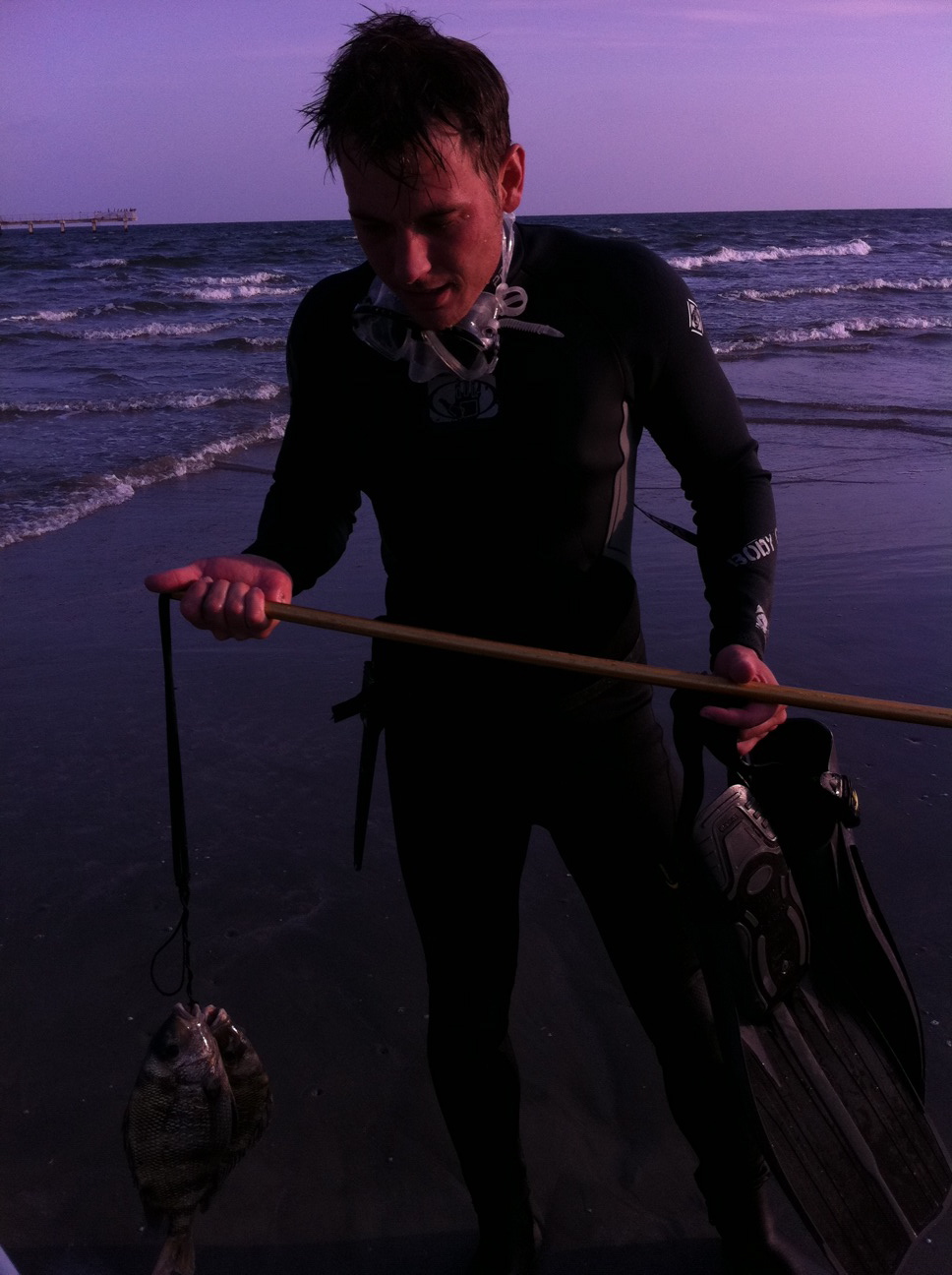
I made a trip to the Flagship, took my surfboard and spear out, and went to town. I got two beautiful sheepshead and I stopped there. The viz, when I got there, was more like three feet and a little choppy, so although it wasn't great, if you really want fish, it was perfect. 

Spear diving or spear fishing? I'm sure you can say both and be correct. I like to say spear diving because to me its just as much about the diving as it is the fishing. Maybe I should say dive fishing? Now I'm confused. Well whatever I end up calling it, I would suggest it to anyone. All you need is a nice spear, a mask and fins, and a little bit of training on holding your breath.

Do you have any spear diving stories or suggestions? Post them in the comments below or email me at NeptuneNation@gmail.com.

If you've never been here before, Welcome to Neptune Nation, where Water is Life.

Brett

Wednesday, March 30, 2011

Travis McGee on Cars


People hate their cars. Daddy doesn't come proudly home with the new one anymore, and the family doesn't come running out, yelling WOW, and the neighbors don't come over to admire it. They all look alike, for one thing. So you have to wedge a piece of bright trash atop the aerial to find your own. They may be named after predators, or primitive emotions, or astronomical objects, but in essence they are a big shiny sink down which the money swirls--in insurance, car payments, tags, tolls, tires, repairs. They give you a chance to sit in helpless rage, beating on the steering wheel in a blare of horns while, a mile away, your flight leaves the airport. They give you a good chance of dying quick, and a better chance of months of agony of torn flesh, smashed guts and splintered bones. Take it to your kindly dealer, and the service people look right through you until you grab one by the arm, and then he says: Come back a week from Tuesday. Make an appointment. Their billions of tons of excreted pollutants wither the leaves on the trees and sicken the livestock. We hate our cars, Detroit. Those of us who can possibly get along without them do so very happily. For those who can't, if there were an alternate choice, they'd grab it in a minute. We buy them reluctantly and try to make them last, and they are not friendly machines anymore. They are expensive, murderous junk, and they manage to look contemptuous of the people who own them.
-Travis McGee 

An extremely appropriate excerpt for our modern mess from Pale Gray for Guilt written by John D. McDonald in 1968.

Tuesday, March 29, 2011

Surf's up? Maybe?

I spent my whole life seeing people surf. On vacations when I was little I would rent giant foamy boards and paddle around in the soupy parts and then brag about my monster waves. I was stationed along the coast for 5 years in the Marines and now have been living near one since 2002. But in that entire time, even though I dabbled in it, I never really learned how to actually surf. I mean I did, but not on the level where I could consistently predict and catch waves. Well, that all changed once I moved to Galveston. After many near death experiences I would say that on a mediocre level, I can now do a pretty decent job.

A few weeks ago, Galveston had a perfect day. I stayed out for hours and even went once in the morning, and once in the evening. It was exhilarating! A 4 foot wave felt like 40, and I haven't stopped thinking about it yet. But now I'm faced with a dilemma. Like a cracked-out bum looking for a rock, I too crave another good Galveston surf day. Will it ever come? 

A friend of mine said that best surf in Galveston is during the winter. Why? Well, in Galveston we have a pretty consistent south wind. This drives the water up on land but then when a front hits (a north wind) it slaps that wave in the face and makes it stand up. Pretty simple, eh? Well with the exiting of winter (or whatever we have down here) that means less north winds, Pretty depressing really. So that I am on my toes for next time, I wanted to learn the basics of how waves work.

Wind
The faster it blows (velocity) coupled with how long (duration) and along with how much area is affected (fetch) determines waves. If this is created by a local onshore wind (Galveston) it tends to be messy. If produced by a storm system offshore then it is better, bigger, cleaner. The only remedy for the Galveston situation, like I said earlier, is a north wind after a big south wind build up. The only problem is is that the north wind responsible for the pretty waves is also the thing that flattens it out :(.

Waves
They are formed when the wind blows over the water and makes chop. As smaller chop combines with other chop, it gets bigger and bigger, making patterns of waves. A wave has several parts. The crest (top) the trough (bottom) and the wavelength (distance from crest to crest) and the height (crest to trough). The waves are also measured by frequency and period.  Period is the time between crests, frequency is the amount of waves over a fixed point in a given time. Longer period waves tend to be stronger, shorter ones disperse a little easier. By using frequency and period based off an offshore buoy, you can determine (kinda) what is to be expected once it hits shore.

Speed
Wave speed is related to its period. The smaller a period, the smaller the wave, the slower it goes. Think about mass and momentum. The longer period waves are bigger and contain more mass and therefore can move at and maintain those faster speeds. 

Bathymetry, beach shape
Bathymetry is the study of the sea bed. When these swells move into areas that are shallow they lose energy quickly. If it were to go from deep ocean right onto the beach then massive waves are created (Hawaii). This is why Galveston is not like the North Shore. But Galveston does have a series of 3 sand bars. When a swell hits an obstacle (sandbar) it will create a bigger wave than a swell moving up a sloping beach. This is why Galveston really has some good days. Also, with all the jetties and groins along the seawall, it creates some "artificial" sandbars that make the waves break almost right at the jetty line. Without these, Galveston may be smooth a flat.

Other factors
Tide, swell direction, refraction, and local winds are other contributing factors. Local winds are a big factor here in G-town. Another one specific to here would be reflection. Anyone who has surfed near the groins can see waves reflected off of them. Sometimes they help, sometimes they just mess it all up. When the wind is coming straight in it is no problem, but if its off to the side it creates a little too much chop.
That was a cold January

In a nut shell, there it is. I wish there was surf everyday, no lie, but I think studying it and waiting for it makes it that much better. In my constant quest to reach true waterman enlightenment, I feel it is these things that help me better understand our relationship with the sea.

What is your relationship with the sea, and how do you interact? Post your responses in the comment section below. 

Drop me a sonar ping at NeptuneNation@gmail.com for a suggestion of what you would like to see on here in the future.

Water is Life

Brett

7ZFXGPTAV3K8